










A BASIC Path to Prosperity: 5 Financial Steps Every Woman Should Consider


What does it take to achieve financial prosperity? Specifically, how should women approach this goal? These days, these questions come into more focus. Women have more money, power, and are in charge of their own finances now than ever before, with about 42% of U.S. adults “unpartnered” (not living with a spouse or partner).1
Further, recent Fidelity research finds 71% of women invest in the stock market, up from 60% in 2023.2 Young women continue to lead participation. Fidelity reports 77% of Gen Z women and 74% of Millennial women invest in the stock market, compared to 65% and 70% for Gen X women and Baby Boomer women, respectively.3 Despite this increased interest and action to stabilize their financial world, women are yet faced with distinct challenges: financial pressure as a caregiver, experiencing a costly health care event, being underserved by an existing financial professional, not knowing where to start in taking charge of their financial wellness, and the list goes on.
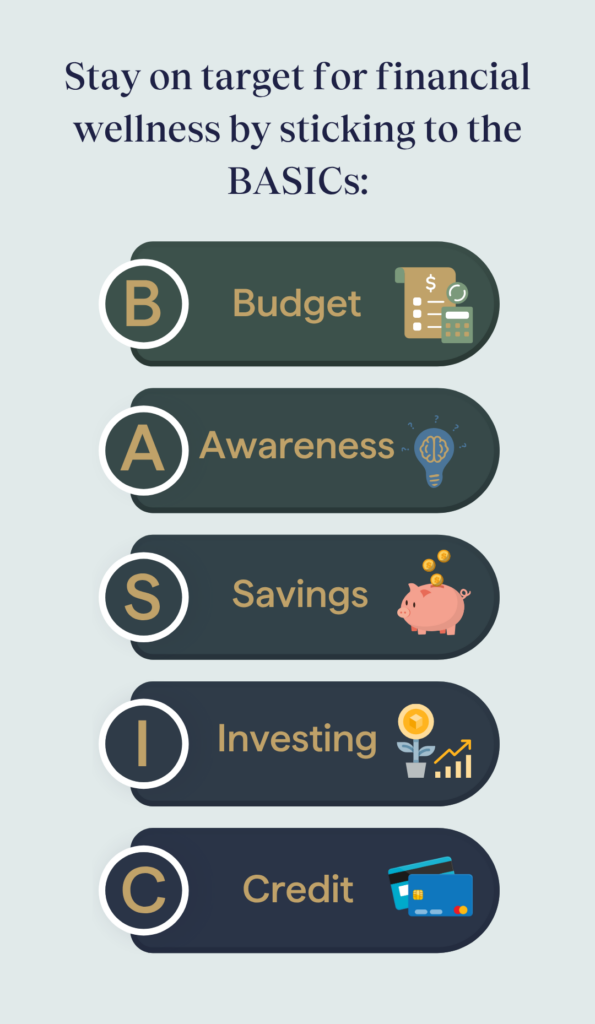
So, how can women approach their goal of achieving financial prosperity? At the core are what we call the five BASIC steps: Budget, Awareness, Savings, Investing, and Credit. We believe these concepts apply at any stage in life, but they are especially important to a young woman’s financial journey, whether single, married, has recently entered the workforce, or is bound for college. Let’s get started.
 BASICs: BUDGET
According to Fidelity Investments’ 2025 research, women continue to lag men in emergency savings, even as many prioritize building reserves. Nearly one-quarter of women report having less than $1,000 saved for emergencies, and one in five have no emergency fund at all, compared with one in ten men.4 Building a budget and, more importantly, sticking to it, allows you to take an honest look at your spending and be in control of your finances. It also helps you become comfortable with basic accounting concepts. Whether using an Excel spreadsheet, a Google Sheets document, or a more interactive online option, many of these options are available on the web for free.
Once you build a budget, be disciplined and stick to it. Avoid the trap of mental accounting; it is easy to think you can keep track in your head of what you are spending in a month, or be forgiving to yourself about that ‘impulse buy’ as a treat because you had a bad day at the office. Also, always look to find opportunities to allocate more to savings and investing when possible.
- Take time to enter your income and spending, then break down your spending into categories (groceries, utilities, clothing, entertainment, travel, etc.). Try the 1919 personal expenses worksheet.
- If you see places where you can cut back on spending or if you have extra money left over each month after paying bills, commit to setting some aside in a savings or investment account.
- Here you will find a budget and checklist tool that can help you plan for unexpected events or transitions from one situation to another.
BASICs: AWARENESS
Staying aware of and understanding the different circumstances that are likely to create an uncertain financial environment at different stages of life reduces fear and helps you adapt quickly.
For example, women live longer than men and therefore need more savings at retirement to maintain the same level of income throughout their lifetimes. On average, a 70-year-old woman can expect to live over two years longer than a man.5 A long life means more years of funding living expenses, which puts pressure on your investments to grow at a strong rate for a longer period of time. Thus, many of us will need our money to last longer in retirement or when we are no longer able to work – even if many choose to retire later.
Get comfortable understanding some economic factors that affect your daily life. For example, an increase in inflation raises the cost of goods and services while reducing the purchasing power of our dollars.
Other factors to be aware of are the changes to retirement savings during your working years. Over the past 20 years, the types of employer-sponsored retirement plans have shifted from pension or defined benefit plans (where employers had the full burden of contributions and investment risk) to 401(k) plans (where the contribution responsibility and investment risk fall to employees).
BASICs: SAVINGS
With awareness of the multiple factors that can support or obstruct your path to financial prosperity, it’s time for action: be prepared for the unexpected by focusing on your savings.
Once you develop and become comfortable with your budget, you will understand how much excess income you earn each month and can allocate that amount to savings. First, build a small buffer (e.g., $1,000) in your checking account to avoid overdrafts and fees. Next, focus on building your emergency fund, which should be worth 3 to 6 months of your current living expenses. With this fund, you can cover bills even during unexpected events, such as losing a job, caregiving, or a medical emergency. Maintain your emergency fund in cash (checking or savings account) or cash equivalents (e.g., CDs, T-Bills, or money market mutual funds).
BASICs: INVESTING
Savings and investing are linked – you need savings to be able to invest. Investing allows your money to grow over time, but it can be challenging to determine how much to invest and when to start. You’re not alone with these questions. According to a 2025 survey, more than 70% of women say they feel confident managing personal finances, like paying bills, maintaining good credit, and saving for emergencies, yet less than half report confidence with long-term financial tasks such as investing or retirement planning.6 Further, 58% of women say investing intimidates them, and 48% are embarrassed that they don’t know more about investing.7
After having built a robust emergency fund, you are ready to begin investing; keep in mind your various short, intermediate, and long-term goals:
- Short-Term Goals (next 3-5 years): Determine the needs for your paycheck, such as a new computer, trips, etc. Keep liquidity for short-term spending needs in a checking or savings account, or in cash, cash equivalents, or short-term bonds (fixed income).*
- Intermediate-Term Goals (5 years-lifetime): For expenses such as buying a home, paying a deposit on an apartment, or starting a business. Use taxable savings or a brokerage account, and invest in stocks, short-term, or intermediate-term.*
- Long-Term Goals (retirement and your legacy): For expenses such as retirement, leaving a legacy for family members, giving to charities, or making an impact on society, etc., assets such as stocks, bonds, and potentially alternative assets (e.g., real estate, commodities, hedge funds, or private equity) can be the right approach using vehicles such as certain forms of trusts and charitable giving funds.*
*These are general examples of vehicles and asset types that investors might consider given goals with different time horizons. This is not a specific recommendation to invest on these vehicles or asset classes.
Build the habit of investing systematically. You can set aside a certain amount each month for investing, then add to it monthly, quarterly, or every six months. The key is to be consistent.
Once your investment goals are defined and prioritized, determine your risk tolerance and time horizon in order to develop an asset allocation you feel comfortable with. Avoid extreme positions based on any one outlook. Instead, work to create a diversified portfolio that includes stocks, bonds, and other asset classes, such as real estate and commodities, to decrease portfolio volatility and improve risk-return characteristics.
Knowing how to invest your assets can be intimidating, especially if you lack experience. If you do not have sufficient investable assets to create a diversified portfolio, balanced mutual funds and ETFs can provide diversification benefits right away. These funds offer exposure to stocks, bonds, and other asset classes with even the smallest initial investment. Altering your asset allocation as your goals evolve and your time horizon changes is also important. Target-date funds gradually shift your asset allocation over time to match your specified time horizon and can be a great option for investors who would rather not make those investment decisions themselves.
Prioritize your money’s time in the market versus “timing the market.” Many people chase fad investments (e.g., “meme” stocks), which is not a sustainable way to build wealth. Invest your portfolio for the long term, as giving your investments more time to grow is a key factor in achieving financial prosperity.
BASICs: CREDIT
Building good credit is key to obtaining a lease, the best rates for home and auto loans, passing a background check for a new job, and more. Endeavor to build good credit by becoming an authorized user on a family member’s card, getting your own secured or regular credit card, or obtaining a credit-builder loan. Make regular, on-time payments. Setting up automatic payments is a great way to stay on track. Use a low amount of available credit, and sustain these habits over time. Some key components of your credit are important for the long term, such as the number of on-time payments you have made, having no late or missed payments, and being able to pay off the debt you do incur.
Balancing your debt is tied to maintaining good credit. Before you sign up for a new credit card, review the terms that apply, especially after an introductory period when the interest rate is lower. From time to time, research and compare your current interest rate. When applying for a loan, review the terms and interest rate to reduce the amount of debt and/or the time frame of paying off the loan. The commitment to doing periodic research may benefit your financial future; awareness of your credit and debt is just as important as your commitment to long-term savings.
Get Started
These BASIC steps and components can help you achieve financial prosperity. Everyone’s financial journey is different, and our 1919 Women & Wealth team is here as a resource for you. We strive to best serve our clients with their unique and unexpected challenges through evolving times. Our team understands the distinct financial planning challenges and opportunities women face at various stages of their lives, even when these challenges are unexpected.
Reach out to us when you are ready for an advocate to help you navigate your path to financial prosperity.
FOOTNOTES
1Fry, Richard. “Share of U.S. Adults Living Without a Romantic Partner Has Ticked Down in Recent Years,” Pew Research Center. January 8, 2025.
2“2024 Women & Investing Study,” Fidelity Investments, October 2024
3“2024 Women & Investing Study,” Fidelity Investments, October 2024
4“2025 Women & Money Study: New Fidelity Research Shows Women Embracing Financial Frugality, Prioritizing Long-Term Savings,” Fidelity Investments. October 29, 2025
5“Actuarial Life Table (Table 4C6),” Social Security Administration, Office of the Chief Actuary. 2025
6“Women Confident Managing Short-Term Finances, but Less So on Long-Term Strategies,” New York Life Wealth Watch Survey. March 26, 2024
7“2024 Women & Investing Study,” Fidelity Investments. October 2024
About 1919 Investment Counsel
1919 Investment Counsel is a registered investment advisor. Its mission for more than 100 years has been to provide investment counsel and insight that helps families, individuals, and institutions achieve their financial goals. The firm is headquartered in Baltimore and has offices across the country in Birmingham, Cincinnati, New York, Philadelphia, San Francisco and Vero Beach. 1919 Investment Counsel seeks to consistently deliver an extraordinary client experience through its independent thinking, expertise and personalized service. To learn more, please visit our website at 1919ic.com.
Disclosures
The information provided here is for general informational purposes only and should not be considered an individualized recommendation or personalized investment advice. No part of this material may be reproduced in any form, or referred to in any other publication, without the express written permission of 1919 Investment Counsel, LLC (“1919”). This material contains statements of opinion and belief. Any views expressed herein are those of 1919 as of the date indicated, are based on information available to 1919 as of such date, and are subject to change, without notice, based on market and other conditions. There is no guarantee that the trends discussed herein will continue, or that forward-looking statements and forecasts will materialize. This material has not been reviewed or endorsed by regulatory agencies. Third party information contained herein has been obtained from sources believed to be reliable, but not guaranteed.
There is no guarantee that employees named herein will remain employed by 1919 for the duration of any investment advisory services agreement.
1919 Investment Counsel, LLC is a registered investment advisor with the U.S. Securities and Exchange Commission. 1919 Investment Counsel, LLC, a subsidiary of Stifel Financial Corp., is a trademark in the United States. 1919 Investment Counsel, LLC, One South Street, Suite 2500, Baltimore, MD 21202. ©2026, 1919 Investment Counsel, LLC. MM-00002380
Published: May 2026