










A Closer Look at Private Market Investments and Their Role in Portfolios


KEY TAKEAWAYS
- Private markets have grown dramatically over the past several decades, fueled by strong returns at the outset, a prolonged period of low interest rates, and a decline in traditional bank lending. Access is expanding beyond institutional investors and may increasingly become available to high-net-worth and retail investors through regulatory and industry initiatives.
- More recently, increased competition in private equity (PE) has driven acquisition prices higher and reduced excess return opportunities. Additionally, higher interest rates have increased borrowing costs and reduced the financial benefits of leverage, a key driver of PE returns over the past two decades.
- Private investments offer potential benefits, including diversification and an opportunity to invest in a growing pool of private companies. However, they also involve meaningful trade-offs. These include long lock-up periods, redemption restrictions, high management and administrative fees, reduced transparency, and infrequent valuations, which are typically based off estimates rather than market transactions.
Investor interest in private equity (PE) and private credit (PC) has grown significantly over the past two decades. Once reserved largely for institutional investors, these investments are increasingly being offered to a broader range of investors, including family offices, high-net-worth individuals, and retail investors.
The growing popularity is driven by the potential for higher returns, enhanced income potential and diversification beyond traditional public markets. Additionally, many companies today are remaining private for longer periods, allowing private equity investors to participate in their growth and value creation before they become publicly traded. However, these potential advantages come with meaningful trade-offs, including reduced liquidity, limited transparency, extended lock-up periods, and higher fees.
As private investments become a larger share of investor portfolios, it is important to understand not only the potential benefits, but also the limitations and unique characteristics.
A Closer Look at the Growth of Private Markets
At a basic level, PE firms invest in privately held companies with the goal of increasing their value and ultimately making a large return when exiting the investment through an IPO, acquisition, or other transactions. Philosophically, PE firms are not long-term investors seeking to buy long-term compounders of growth. Rather, they typically invest in businesses to improve and then sell, often using leverage to boost potential returns. PC investors provide loans to businesses in order to earn a higher yield than what is available in public debt markets, often serving borrowers that have limited access to traditional financing because of credit quality concerns.
PE first emerged in the 1970s and 1980s as a niche investment strategy that was highly profitable for both investors and PE firms. At the time, there were approximately fourteen PE firms. Today, there are thousands of PE firms, with assets growing to approximately $28 trillion today, exceeding the roughly $23 trillion held by the entire US commercial banking industry.
A key catalyst for this growth was the success of Yale University’s endowment under David Swensen, which came to be known as the Yale model. Beginning in 1985, Swensen delivered exceptional returns by allocating substantial capital to PE and other alternative investments, influencing many institutional investors to follow a similar approach.
The expansion of private markets accelerated further following the 2008 Global Financial Crisis, when central banks lowered interest to near zero and maintained highly accommodative monetary policy for much of the following decade. For PE firms, low borrowing costs made it easier to fund new deals with debt, while declining discount rates and ample liquidity supported higher asset valuations, boosting returns independent of the underlying companies’ performance.
Low rates also increased investor demand for private market investments. With traditional fixed income yields at historic lows, many institutional investors found that traditional portfolios, particularly the classic 60% stock / 40% bond allocation, were unlikely to generate returns that were sufficient to meet their future obligations. As a result, investors increasingly turned to private markets for enhanced return and income opportunities.
At the same time, banks tightened lending standards following the Global Financial Crisis and reduced their appetite for certain types of loans, creating an opportunity for PC funds to fill the financing gap. These funds provided financing directly to businesses outside of the traditional banking system, often offering greater flexibility and faster execution than regulated lenders, albeit at higher borrowing costs.
Together, these forces fueled the rapid expansion of private investments as firms benefited from abundant and inexpensive financing, while investors increasingly sought alternative sources of return. Additionally, businesses gained access to a growing pool of private capital that could support acquisitions, expansion plans and other financing needs.
Recent Headwinds to PE Returns
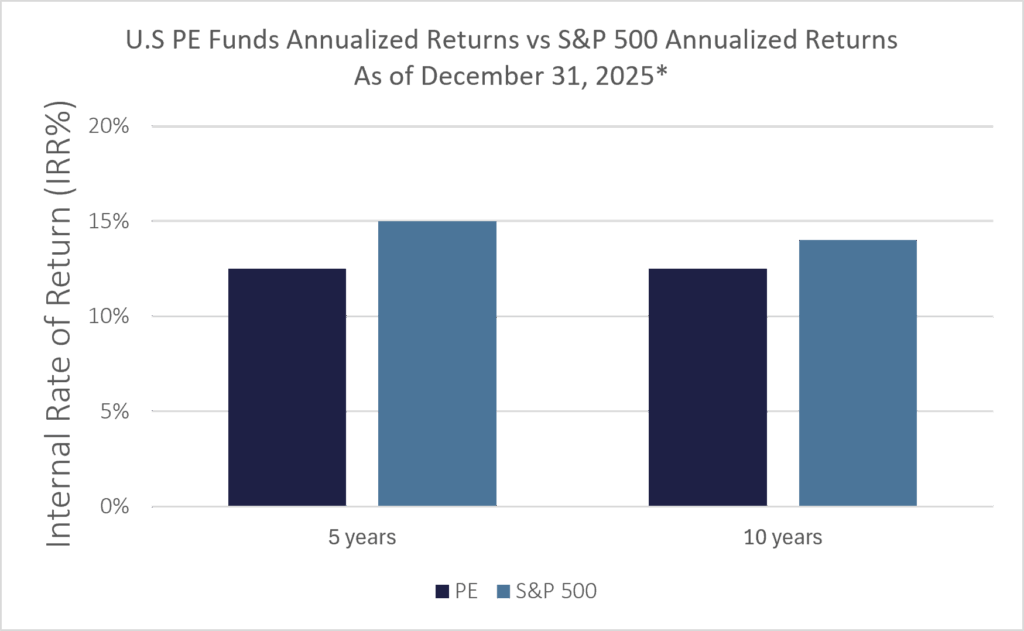
As capital flowed into private markets, competition for investment opportunities intensified, creating a potential headwind for PE returns. Increased demand for deals drove acquisition prices higher, reducing the return premium relative to public markets that contributed to the early success of the Yale model.
Higher interest rates are also creating additional challenges for the asset class. Higher financing costs reduce the benefits of leverage, a key driver of PE returns over the past two decades. Existing portfolio companies may also face pressure as maturing debt is refinanced at higher rates, increasing interest expense, reducing profitability, and ultimately weighing on investment returns.
*Assumes Accuracy of Unsold Investments’ Valuations
Source: Jeff Hooke, Bain, McKinsey, State Street. Includes effect of Credit Lines.
Taken together, these developments suggest that the favorable conditions that supported PE’s rapid growth and strong historical performance may prove more difficult to replicate in today’s environment.
Policy and Industry Initiatives May Expand Access to Private Markets
It is noteworthy that, even as the private market landscape has become more competitive and returns have moderated, policy initiatives and industry developments have simultaneously expanded efforts to make private investments more accessible to individual investors.
Following President Trump’s announcement supporting broader access to alternative investments within retirement plans and 401(k)s, regulators have been encouraged to revisit rules and fiduciary guidance that have historically limited exposure to private markets. If implemented, these changes could significantly expand the pool of investors able to access private investments, including many who have traditionally been excluded from this asset class.
At the same time, new investment platforms are also lowering barriers to entry, while fund managers are launching semi-liquid vehicles, such as interval funds, evergreen funds, and business development companies (BDCs) that offer greater flexibility than traditional drawdown funds. These structures typically allow investors to subscribe on an ongoing basis, often require lower minimum investments and may provide periodic liquidity through limited redemption programs. As a result, private investments that were once largely reserved for institutions are becoming increasingly available to a broader range of investors.
Risk/Return Trade-Offs of Private Investments
While these innovations have improved access and simplified the investor experience, they do not eliminate the fundamental characteristics of private investing. Investors should recognize that these vehicles still invest in illiquid assets, may impose redemption limits during periods of market stress, and often rely on valuations that are not continuously tested in public markets.
Additionally, despite the recent decline in PE returns relative to the S&P 500, private investments continue to be marketed as offering higher returns, enhanced income potential and lower reported volatility than public market investments. Their perceived diversification benefits and access to investment opportunities not available in public markets can be particularly appealing, during periods of market volatility, economic uncertainty, or elevated public market valuations.
However, while the potential benefits are frequently marketed, the risks may be less widely understood. These include limited liquidity, reduced transparency, valuation uncertainty, higher fees, and extended lock-up periods that may restrict access to capital for years at a time. As with any investment, the potential for higher returns should be evaluated alongside these risks, as well as the investor’s liquidity needs, time horizon, and overall financial objectives.
Complexity Does Not Always Lead to Outsized Returns
Institutional portfolios have evolved significantly over the past several decades. What was once the traditional 60% stock / 40% bond allocation has increasingly been replaced by more complex portfolios that include substantial allocations to illiquid investments such as PE, PC, hedge funds, real estate, and other alternative investments.
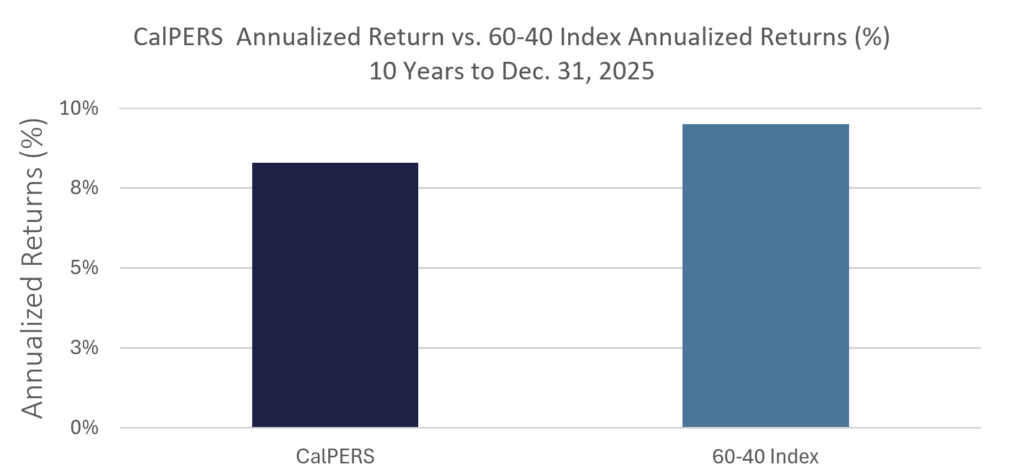
However, this increased diversification and complexity have not always translated into better investment outcomes. CalPERS (The California Public Employees Retirement System), the nation’s largest public pension plan with over $600 billion in assets and approximately 2.4 million members, has recently drawn attention for its allocation to private investments. An independent report published in May 2026 concluded that CalPERS, which has roughly 30% of its portfolio allocated to private investments, underperformed a simple 60% stock /40% bond portfolio over the decade ending December 31, 2025. The report also highlighted concerns regarding the higher fees associated with private investments.
According to the study, CalPERS generated an annualized return of 8.3%, approximately 120 basis points below the 9.5% annualized return of Vanguard’s Balanced Index Fund over the same period. The report further noted that CalPERS ranked in the bottom 5% of public pension funds during that timeframe.
*Assumes Accuracy of Unsold Investments’ Valuations.
Source: Jeff Hooke, CalPERS and Vanguard. CalPERS return shown net of investment expenses.
This is not a standalone example. According to a related analysis, approximately 95% of state pension plans with significant allocations to private investments failed to outperform a passive 60% stock / 40% bond portfolio index over the last 10-12 years¹. Similarly, studies examining endowments with high allocations to private investments found that excess returns relative to S&P 500 have compressed to near-zero over the past five years.²
This is not to suggest that all private investments universally underperform. Rather, it highlights the fact that an allocation to private investments does not guarantee superior results, particularly after fees and liquidity constraints are considered.
Liquidity Tradeoff: Lock-Up Periods and Redemption Limits
Unlike publicly traded stocks and bonds, private investments often require investors to commit capital for extended periods through lock-up provisions that restrict redemptions. Depending on the investment structure and underlying assets, these lock-up periods can range from one year to ten years or more.
Even after an initial lock-up period expires, investors often remain subject to redemption gates, contractual provisions that limit the amount of capital investors can withdraw at any one time. Redemptions are typically only permitted during specific windows, often quarterly, and usually require advance notice. Moreover, investors may be limited to withdrawing only a certain percentage of their investment during each redemption window.
When the fund’s aggregate redemption requests exceed its allowable threshold, withdrawals may be prorated, resulting in investors receiving only a portion of the amount requested. The remaining balance may be deferred to future redemption periods and, in some cases, may take months or even years to be returned in full. Consequently, investors may have substantially less access to their capital than anticipated, particularly during periods of market stress when liquidity is most valuable.
These liquidity constraints became particularly evident during the Global Financial Crisis. As market conditions deteriorated, many investors sought to redeem capital from PE and other alternative investment funds but were unable to because of the lockups, redemption gates, and fund-level restrictions. At the same time, PE firms faced their own liquidity challenges as investors struggled to meet capital call obligation as their public investments declined sharply.
This liquidity risk came into focus again earlier this year, as concerns surrounding certain PC investments due to weakness in the highly leveraged software industry triggered a wave of redemption requests. Because these funds could not meet all requests simultaneously, redemption gates and withdrawal limits were imposed, preventing investors from getting their capital when they wanted it.
Both recent experiences underscore the liquidity constraints associated with these investments and the trade-off investors make between perceived stability and liquidity.
Why Private Market Valuations Can Be Less Transparent
Limited public information, inconsistent reporting practices, and the lack of readily observable market prices can make it difficult to determine the fair value of privately held companies and loans. While public securities are continuously priced by the market throughout each trading day, private investments are typically valued only periodically by fund managers and auditors using financial models, assumptions and comparable transactions.
As a result, the reported value of a private investment may not always reflect its current market-clearing price. This distinction becomes particularly important during periods of market stress or heightened volatility when public market prices adjust rapidly to changing conditions, while private market valuations appear largely unchanged. Consequently, private investments often exhibit lower reported volatility than publicly traded securities, although this may reflect valuation practices rather than underlying investment risk.
Recent developments in the PC market illustrate these challenges. In late 2025 and early 2026, a large private fund valued certain loans at par ($100) before subsequently marking them down to zero just three months later. The abrupt markdown raised questions about whether the loans had been valued appropriately and whether deteriorating credit conditions had been reflected in the reported valuations on a timely basis. It also raised concerns that there might be similar issues at other funds.
More broadly, this episode highlighted concerns about the subjectivity of private market valuations, and the difficulty investors may face in determining the true value of certain private assets. It also serves as a reminder that lower reported volatility does not necessarily mean lower risk.
The Impact of Estimated Values on Performance
Valuation uncertainty can also affect how a fund’s overall performance is measured. When a significant portion of a portfolio remains unsold, reported returns may rely heavily on estimated valuations rather than realized transaction values.
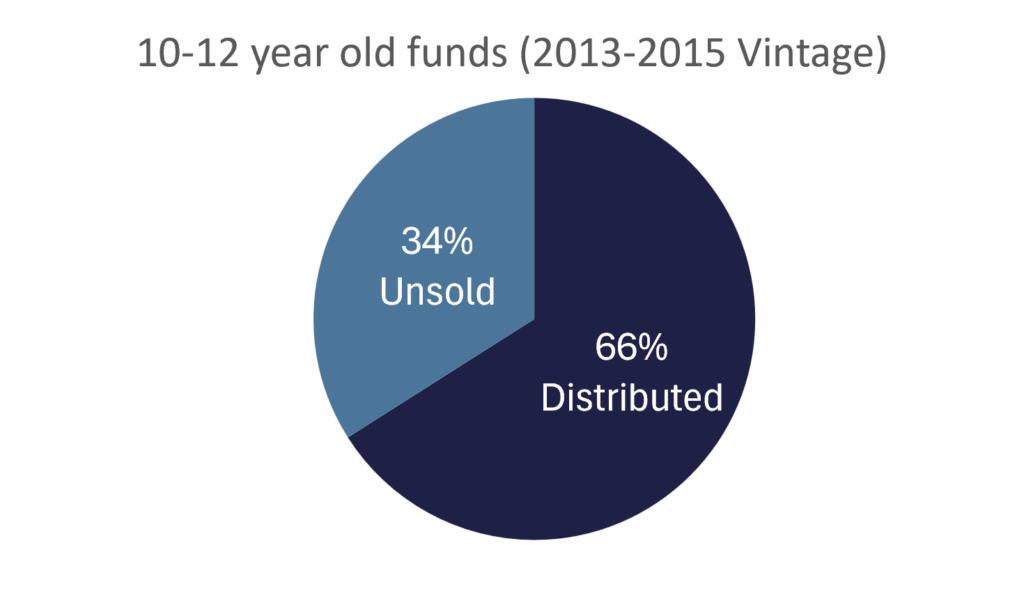
According to research done by Johns Hopkins University professor Jeff Hooke, approximately 34% of the value of 2013-2015 vintage funds (funds that are now 10 to 12 years old) remain unsold or unrealized, while investors in 2016-2018 vintage funds (7 to 9 years old) have realized only about half of total value through exits. As a result, commonly cited performance metrics such as Total-Value to Paid-in-Capital (TVPI) and Internal Rate of Return (IRR) may be based, in large part, on unsold businesses, which are estimated values that have yet to be realized through an actual sale or liquidity event. Accepting this estimate is a critical assumption since many PE funds that are 12 years and younger have unsold assets comprising a considerable portion of their cumulative value.
Source: Jeff Hooke. *The TVPI (also known as investment multiple) is a measure of the performance of a PE fund relative to the initial investment. It represents the total value of a fund relative to the amount of capital paid into the fund to date.
This does not necessarily imply that the valuations are inaccurate. Rather, investors should recognize that both the ultimate value of an investment and the timing of liquidity remain uncertain until the underlying assets are sold.
Accordingly, it is important to distinguish between realized and unrealized returns when evaluating private investments. While unrealized gains may represent legitimate value creation, they remain dependent on future exit valuations, market conditions and manager assumptions. Until those gains are realized, the final investment outcome remains uncertain.
Higher Fees May Reduce Private Investments’ Returns
Fees are another important consideration when evaluating private investments as returns can be less compelling after expenses are considered. Annual management fees often range between 2% to 4%³ and many funds also charge a performance-based fee, commonly known as carried interest, which allows the manager to receive a portion of the profits before investors do. When combined, these expenses can result in a total cost that is substantially higher than that of traditional stock and bond investments.
In addition to management fees, individual investors may also incur administrative and tax-related costs. Most private funds issue Schedule K-1 tax forms, which are often delivered after the standard April 15 filing deadline, complicating tax preparation and frequently requiring filing for extensions. In addition, private funds typically invest across multiple states, potentially creating additional state tax filing obligations for investors. These added costs may reduce the net investment return while creating additional administrative burdens for investors.
Past Performance Does Not Guarantee Future Results
Another challenge for investors is the wide dispersion of returns across private market funds, as results can vary significantly not only from one manager to another, but also across different funds managed by the same team.
Research suggests that performance persistence in private markets can be less predictable than many investors assume. A study by Johns Hopkins University professor Jeff Hooke found that a manager whose prior fund ranked in the top quartile had only about a 25% chance of producing another top-quartile fund. The underlying investments, economic environment, timing of capital deployment, use of leverage, and exit conditions can all have a substantial impact on results, making future performance difficult to predict even when a manager has a strong track record.
A Thoughtful Approach to Private Investments
When evaluating private investments, it is important to approach the asset class with a clear understanding of its risks, limitations and potential benefits.
As more high-profile companies choose to remain private for longer, investor demand for private market exposure will likely continue to grow. At the same time, policy initiatives and the expansion of alternative investment platforms are making private investments increasingly accessible to a broader range of investors, many of whom may be less familiar with their unique risks and complexities.
While private investments can offer diversification benefits and attractive return potential in certain circumstances, they also introduce additional complexity, liquidity constraints, higher fees and valuation uncertainty that require careful consideration.
Investing in private markets requires a thoughtful assessment of how each investment fits within an overall portfolio objective, considering an investor’s risk tolerance and liquidity needs, and should be grounded in rigorous due diligence and careful manager selection. As with any investment, successful outcomes depend on careful analysis, prudent portfolio construction, a disciplined approach and a clear understanding of both the opportunities and limitations of each asset class in the portfolio.
End Notes
¹ Hooke Imerman DOL-RIN Letter
² Forbes: CalPERS Ushers in New Investment Era with the Total Portfolio Approach.
³ Hooke Imerman Dol-RIN Letter
About 1919 Investment Counsel
1919 Investment Counsel is a registered investment advisor. Its mission for more than 100 years has been to provide investment counsel and insight that helps families, individuals, and institutions achieve their financial goals. The firm is headquartered in Baltimore and has offices across the country in Birmingham, Cincinnati, New York, Philadelphia, San Francisco and Vero Beach. 1919 Investment Counsel seeks to consistently deliver an extraordinary client experience through its independent thinking, expertise and personalized service. To learn more, please visit our website at 1919ic.com.
Disclosures
The information provided here is for general informational purposes only and should not be considered an individualized recommendation or personalized investment advice. No part of this material may be reproduced in any form, or referred to in any other publication, without the express written permission of 1919 Investment Counsel, LLC (“1919”). This material contains statements of opinion and belief. Any views expressed herein are those of 1919 as of the date indicated, are based on information available to 1919 as of such date, and are subject to change, without notice, based on market and other conditions. There is no guarantee that the trends discussed herein will continue, or that forward-looking statements and forecasts will materialize. This material has not been reviewed or endorsed by regulatory agencies. Third party information contained herein has been obtained from sources believed to be reliable, but not guaranteed.
There is no guarantee that employees named herein will remain employed by 1919 for the duration of any investment advisory services agreement.
1919 Investment Counsel, LLC is a registered investment advisor with the U.S. Securities and Exchange Commission. 1919 Investment Counsel, LLC, a subsidiary of Stifel Financial Corp., is a trademark in the United States. 1919 Investment Counsel, LLC, One South Street, Suite 2500, Baltimore, MD 21202. ©2026, 1919 Investment Counsel, LLC. MM-00002636