










Women & Wealth: Navigating Financial Challenges and Unlocking Opportunities


WHEN IT COMES TO PLANNING FOR THEIR FUTURES, WOMEN FACE DISTINCT CHALLENGES.
On average, women in the U.S. live longer and have higher health care costs than men. At the same time, women tend to earn less, under-invest, accumulate less, and incur more debt over the course of their lives. Further, women often face the daunting task of caring for loved ones at the expense of their own energy and resources.
With our experience in working with individuals and families for over a century, we know the impact these challenges can have on your future. Our goal is to work with you to identify how these challenges may impact you, and, more importantly, the opportunities to plan for these challenges.
 Women outlive men by more than 5 years,1 and must be prepared to make their wealth last over a longer period of time.
 Women earn 83.6 cents for every dollar a man earns,2 and need to maximize every opportunity to build wealth during their working years.
 Women report having less financial literacy confidence than men,3 and may have to overcome a knowledge gap in order to protect and grow their wealth.
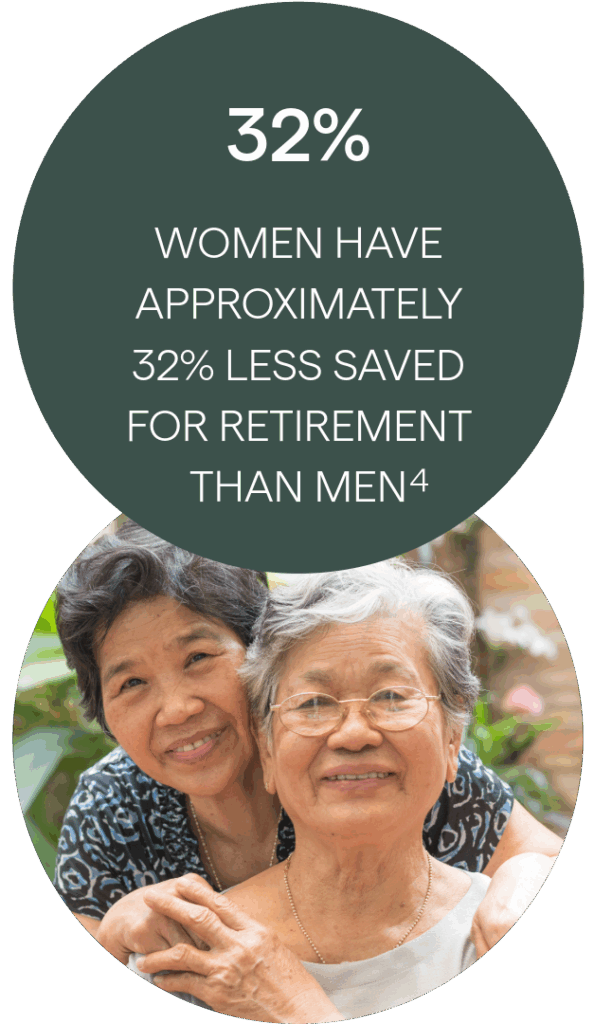
 Women have approximately 32% less saved for retirement than men,4 reinforcing the idea of saving early and saving often.
 Women’s health care spending is roughly 20% higher than men’s,5 and women may need a savings and investment approach that accounts for accelerated costs.
 Women represent 61% of caregivers,6 and not only need to save more to cover the costs of care, but also be prepared for the increased mental and physical toll.
 Women who are single give more to charitable causes and in higher amounts than men,7 and thus need to maximize the philanthropic impact and tax benefits of their gifts.
These issues are complex and interconnected, and together contribute to the startling “wealth deficit” that women of all backgrounds, education levels, and vocations encounter throughout their lives. These challenges can be addressed through a combination of planning, education, and thoughtful decision-making—paving the way for greater financial stability, flexibility, and freedom.
7 KEY PLANNING OPPORTUNITIES
CHALLENGE #1
Women Outlive Men
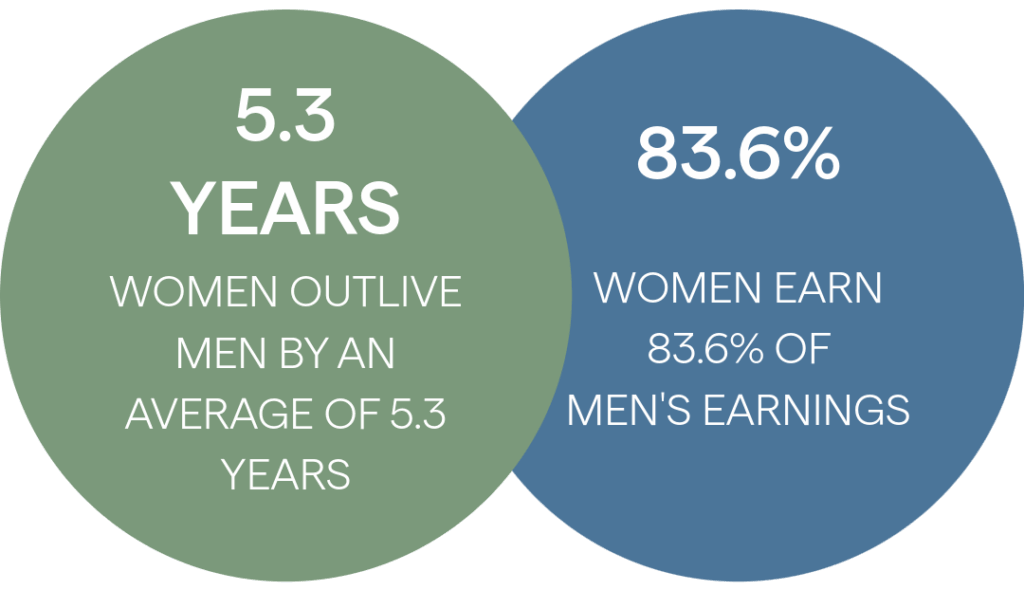
Women currently outlive men by an average of 5.3 years, with U.S. female life expectancy at 81.1 years compared to men at 75.8 years.8 In addition, from age 67 onward, women are 40% more likely than men to live to age 90.9
Living longer means more years to fund living expenses, which in turn puts pressure on your portfolio to generate strong returns for a longer duration. For any individual factoring in longevity, it is vital to address the likelihood of outliving one’s assets and make appropriate adjustments in the planning process.
Without considering the reality of longevity, women — or anyone facing a longer time horizon — are at risk of misallocating investments and trading long-term growth in favor of short-term stability.
 THE OPPORTUNITY
Plan Upfront for a Longer Time Horizon
The simplest way to address this issue is to start investing for retirement and longevity early and in a disciplined manner. This unlocks the benefits of compounding growth, which is key to long-term wealth accumulation. The effect of compounding growth is even more powerful when accumulated over decades in a tax-deferred or tax-free account.
Even if you believe you are “behind” in getting invested, the good and bad news is that you likely have a longer time horizon than you realize. Whether you are in your 20s, 30s, 40s, or a few years away from retirement, compounding growth can work in your favor. Invest as soon as you can, within your ability to tolerate risk.
Retirement or Tax-Deferred accounts: Retirement accounts including Traditional and Roth Individual Retirement Accounts (IRAs) and employer-sponsored plans (e.g. 401(k) plans) are powerful tools in building wealth for those with earned income. They are tax-advantaged, and allow investments to grow while deferring capital gains taxes until they are taken out of the accounts. The earlier you fund the accounts, the better, even with small dollar amounts. Starting with small, steady contributions can have a tremendous impact on the ultimate outcome. There are rules around contributions and distributions for retirement accounts, including income limits. A full understanding of your tax situation is critical in using these tools effectively.
Taxable accounts: Outside of retirement plans, you can invest in a regular taxable account, sometimes called a brokerage account. The key is to identify the asset allocation mix that is appropriate to your time horizon and objectives, and then to stay invested, adding to the accounts regularly. It can be as simple as setting a reminder to invest extra cash on a regular basis (once a month, or once a quarter, for example), or even better, automating the process.
Risk Tolerance: Assessing risk tolerance accurately can be difficult, but is important to arriving at the right asset allocation. This determines how to best position investments to grow over a finite period. If discomfort with short-term market volatility drives long-term investment decisions, you risk jeopardizing the ability to reach important long-term goals. At the same time, if you are invested too aggressively for your risk tolerance, you may end up derailing the investment plan when there is market pullback. The right asset allocation incorporates time horizon, risk tolerance, and short-term cash needs, and should be reviewed regularly. As you gain experience as an investor, your risk tolerance may adjust as well.
Given the likelihood of a longer life span, there is an urgency and need to work towards understanding your true risk appetite in the context of investment goals, and that a thoughtful investment plan is in place to meet those goals within the appropriate risk parameters.
We recommend working with us on a comprehensive financial plan to identify your investment goals and strategies to achieve them.
CHALLENGE #2
Women Earn Less than Men
Women earn 83.6 cents for every dollar a man earns,10 despite earning over half of the bachelor’s degrees in the U.S. While women are paid less than men at every level, data shows that women with advanced degrees are paid less per hour, on average, than men with college degrees.11
Women’s salaries generally start at close to parity with men, but lag in earning power further along in their careers.
In addition to earning lower wages, women are more likely to advance more slowly and face more interruptions in their careers. For every one hundred men promoted to manager, only eighty-one women achieve the same level,12 a gap that continues to widen at higher levels of seniority.
Women are more likely to experience prolonged interruptions in their careers; women consistently report taking time off from working, compared to men, to care for children or other family members. Women are also more likely to work part-time, comprising 60% of U.S. part-time workers.13 In more drastic instances, women report leaving their jobs altogether for caregiving responsibilities, doing so at a higher rate than men.
The financial consequences of taking time out of the labor force are severe, with women experiencing measurable impact with just one or two years out of the workforce. On average, women accumulate 8.6 years of work for every 10 years worked by men, contributing to a cumulative $500,000 income loss over a 30-year career.14
 THE OPPORTUNITY
Build an Emergency Fund, Negotiate, and Prepare for Career Interruptions
These realities affect financial security and independence for women to a greater degree. Even if you are at the peak of your career, you should consider the increased odds of underemployment, career interruption, and lower earnings.
A major opportunity exists in negotiating your salary when the opportunity arises. Typically, switching to a new job, taking on additional responsibilities at your current job, or a promotion or review are good times to ask for a raise.
Look to maximize every advantage available to you during working years. If a company offers a retirement plan with matching contributions, participate early and aim to maximize your contributions consistently over time and ensure you select investments according to your time horizon and risk tolerance. This will mitigate the risks of a savings shortfall if you experience career interruption.
In addition, if retirement plans lack Roth 401(k) contribution options or after-tax contributions, the plans can be amended to add such features if employees ask. Do not overlook non-monetary benefits such as generous maternity and family leave policies.
Finally, these career challenges make it even more important to consider asset allocation, and ensure a cash cushion for emergencies and periods of un- or underemployment. Having access to cash can also help ensure your long-term investment plan remains on track and invested for growth regardless of disruptions. Staying invested according to plan is key to ensuring that career disruptions do not compromise funding your own retirement and financial independence.
CHALLENGE #3
Women Face Lower Rates of Financial Literacy and Independence
In a recent study of divorced and widowed women, 40% of widowed women and 30% of divorced women expressed feeling less confident in handling investing and retirement planning decisions after the loss of a spouse or divorce from their spouse.15
For various reasons, women may find themselves more financially dependent. The greater the dependency, the greater the exposure to loss of income or support. Lack of access to education around financial matters is often the first significant barrier to gaining financial independence. It creates a host of other issues that cannot be easily resolved without first addressing the underlying issue: access to good information to build a solid financial foundation.
 THE OPPORTUNITY
Take Financial Inventory to Protect your Independence and Build Your Financial Confidence
It can be difficult to know where to begin learning. Your own situation is a great starting point before digging into more advanced topics.
Focus your preparation in two ways:
Personal Balance Sheet: Create a personal balance sheet that provides an inventory of your assets, liabilities, and ownership. This may include investment accounts, savings accounts, brokerage accounts, life insurance policies, health savings accounts, equity in partnerships or business interests, property/real estate, and even credit card reward points. Laying out your assets and liabilities on paper is important first and foremost for your own understanding, and can also prompt key conversations with your partner. Such conversations can be catalysts to address and plan for future scenarios.

Benefits: Understand all the benefits available to you. For example, if you are divorced, you may still have access to spousal Social Security benefits based on your ex-spouse’s benefits (given certain criteria are met, including the marriage lasting at least 10 years). In a situation where one spouse earned significantly more than the other, accessing those benefits can greatly impact the monthly Social Security amount. The lower-earning spouse who may have taken a long career break would have a far smaller benefit than the higher earner. After a divorce, the spousal Social Security benefit could still be accessible, which has an enormous impact on the cash flow and security of the spouse with lower earning history.
 Once you begin mastering the basics, build your knowledge base further around estate planning, especially if you have dependents. It’s crucial to ensure that your beneficiaries are up-to-date, especially on your retirement accounts and designated beneficiary accounts.
Protecting your independence can also be achieved by a prenuptial agreement, where the considerations are made while a relationship with your partner is on solid footing.
Life and disability insurance can also be important elements of financial stability.
On their own, these strategies might make a modest impact. However, do not underestimate the compounding positive effects of these strategies over time to drive the financial outcomes you desire. Having the basics in order sets you up to confidently explore more complex questions later, such as tax nuances, private investing, and community impact through philanthropic ventures.
CHALLENGE #4
Women are More Likely to Live Alone
Women are more likely to be single at some point in their lives than men, whether planned or unplanned.
A number of studies provide evidence that divorce creates a costlier economic fallout for women than for men, where a woman’s household income fell by an average of 41% following a divorce, while a man’s household income fell by only 23%.16 Additionally, in divorces among older adults (50 and older), women experience a 45% decline in standard of living, compared to a 21% drop for men.17 When women find themselves alone as a result of the death of a spouse, these effects can be even more severe.
Finding oneself living alone presents clear financial challenges, including loss of income both during working years and in retirement (from Social Security, e.g.), while costs may remain relatively unchanged or only slightly reduced.
 THE OPPORTUNITY
Protect What You Earn and What You Have
There are concrete steps you can take to protect yourself from the financial burdens of being or becoming a single-income household.
Life insurance policy: An up-to-date life insurance policy on your partner is a basic step that can protect a financially dependent survivor. It is important to ensure that the amount of the policy is appropriate, so that a family is not under- or over-insured. Consider buying life insurance on the spouse who does not work outside of home, but who is providing essential support and work inside the home. Consider how much it would cost the family to hire individuals to provide the work that is covered by the partner who stays at home or works part-time.
Disability insurance: This insurance can help to offset the loss of income, should you or an earner upon whom you depend become unable to work. Disability insurance is a historically under-utilized tool, leaving many exposed to the risk of income loss.

Beneficiary reviews: Ensure that your beneficiaries are correct on all accounts. Check accounts where you are the beneficiary, as well as ones where you are the owner. Check your retirement accounts, Transfer-on-Death accounts, Health Savings Accounts, Trusts, and life insurance policies to ensure that your wishes are current, especially in a second marriage or partnership situation.
CHALLENGE #5
Women Pay More for Health Care
The availability of health care and the cost of care are major concerns in planning for women. Women spend 20% more on health care than men across all age groups.5
As of 2023, roughly 90.5% of adult women (ages 19-64) have health insurance; nearly 1 in 10 remains uninsured.18 However, coverage varies significantly by state: only 2.6% of women are uninsured in Massachusetts, versus 22% in Texas.19
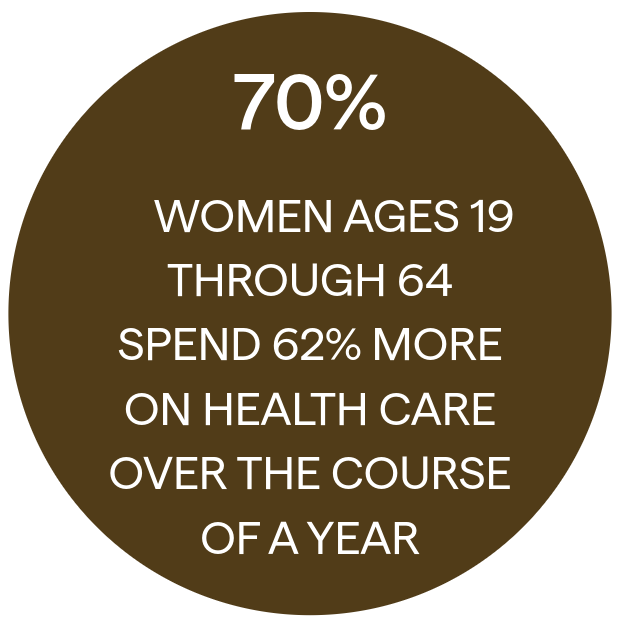
On average, a healthy 65-year-old woman retiring in 2024 could expect to spend approximately $147,000 to $320,000 on healthcare over her remaining lifetime, depending on coverage.20 Strikingly, for working adults (ages 19-64), women spend approximately 70% more per capita on healthcare, compared to men in the same age group, possibly attributable to maternity care costs.21
Health care costs affect many financial planning factors, including future spending projections and your ability to save towards long-term investments. Higher medical costs today impede cash flow tomorrow, and make it more difficult to save and invest for retirement on a regular basis.
 THE OPPORTUNITY
Account for Higher Costs, Explore Health Savings
Evaluate whether or not you have the right health insurance in place, and consider all options that can help you build as much of a cushion as possible for future expenses.
Health Savings Account: One option worth exploring is a Health Savings Account (HSA), which can provide a triple-tax advantage: pre-tax contributions, invested funds that grow tax-sheltered, and tax-free withdrawals for qualified medical expenses. Unlike Flexible Savings Accounts (FSAs), which must be used in a plan year, HSAs can accumulate year after year towards larger medical expenses in the future. Currently, HSAs are available to those with a high-deductible medical insurance plan. Contribution limits and other rules around FSAs and HSAs may change each year, so it is important to stay up to date.
As health care costs can snowball quickly and jeopardize financial stability, women must choose health care coverage and insurance wisely.
CHALLENGE #6
Women Tend to be the Primary Caregivers
Globally, women are the predominant providers of unpaid care for family members with disabilities or chronic medical conditions. Estimates indicate that the share of female caregivers was 60% in the U.S. and 81% globally.22
This is a multi-faceted issue:
The physical and mental toll: Studies have shown that women experience greater mental and physical strain while providing care. Compared to male caregivers, women are more likely to report higher levels of depression and emotional burden, and they take on more caregiving tasks.23 This strain often manifests in personal health issues that arise after the initial caregiving phase is over, and also jeopardizes their ability to achieve their own goals.
Financial impact: Caregivers may be responsible for shouldering all or part of the financial burden of providing care. National median cost for a private room in a U.S. nursing home is $361 per day, or about $10,965 per month.24 This is yet another contributing factor to stunted career advancement for women, who may compromise their highest earning years while providing a disproportionate amount of care. The financial aftermath of providing care may extend far beyond the years of actual caregiving.
 THE OPPORTUNITY
Develop an Elder Care Plan
Multigenerational caregiving for elderly parents or disabled family members can cause a trifecta of financial, emotional, and physical difficulties. There is a clear need to plan for long-term care, involving both dollars and emotional impact. The more difficult the conversation, the easier to avoid or delay important decisions which will only exacerbate the situation.
Elder Care Planning: The need for care often arises unexpectedly and before a plan is developed and discussed. Consider developing a care plan to document the needs and desires of the relative who may require care, key trusted contacts for emergencies, doctors’ information, medications, health conditions, and locations of relevant documents. This conversation can be a good way to ensure key legal and estate documents are in place and updated. The documents include but are not limited to a Will, a Living Will, a Health care power of attorney, Durable financial power of attorney, HIPAA release form, and in some cases a Revocable Trust.
Understanding the potential financial impact is key to planning. For example, it is crucial to understand that long-term care expenses are generally not covered under health insurance, and is only covered under limited situations for a finite period of time under Medicare.
Starting the process early enough can help you get ahead of the financial and emotional challenges of caring for an elderly parent, family member, or yourself. As part of the process, you can research the states and cities that have lower costs for professional nursing care. You can also work with a Medicare consultant on optimal policies in your area, consult a reputable elder care attorney, and evaluate long-term care insurance options. Even thinking through a “worst case scenario” can open the door for productive conversations.
CHALLENGE #7
Women Lead the Way in Philanthropy
Single women are more likely to give to charity, and in greater amounts, than men.25
In recent years, women’s giving has emerged as a force in the world of philanthropy. Women are also more likely to consider social responsibility and impact when making investment decisions. The challenge to overcome here is to help women unleash the full potential of their philanthropic power. If women globally make progress towards defeating the financial challenges they face over their lifetime, then everyone benefits.
 THE OPPORTUNITY
Aim for the Greatest Impact with Donated Dollars
From an investment standpoint, there are many ways to achieve a greater impact. Effective tax planning through strategic charitable giving can result in a higher net donation to the charity. There are rules associated with deductibility in giving cash versus stocks, but exploring all avenues will help maximize charitable impact and tax benefits. You can also consider incorporating values- aligned investments in the portfolio strategy.
Multiple tools are available for tax-efficient giving to charity. One example is a Donor Advised Fund (DAF).
Donor Advised Fund (DAF): As part of an overall wealth planning strategy, a DAF allows donors to give a large donation in one year, and decide in future years when and how much to give to specific charities. This approach offers an immediate tax benefit to you as the donor, and can help charities over time by providing donors a way to give sustainable, regular contributions, boosting stability in donations. A DAF may work well in a situation with highly appreciated stock or another type of asset.
Qualified Charitable Distributions (QCDs): IRA owners who are at least age 70.5 have the ability to make a QCD, or a direct donation to a charitable organization from an IRA. A distribution that qualifies as a QCD will not
be included in your taxable income. QCDs are subject to annual limits and can be an effective way to donate to charity while saving on income taxes. Whether you should make a QCD, use a DAF, or another method of charitable giving will depend on your unique situation.
WHAT’S NEXT
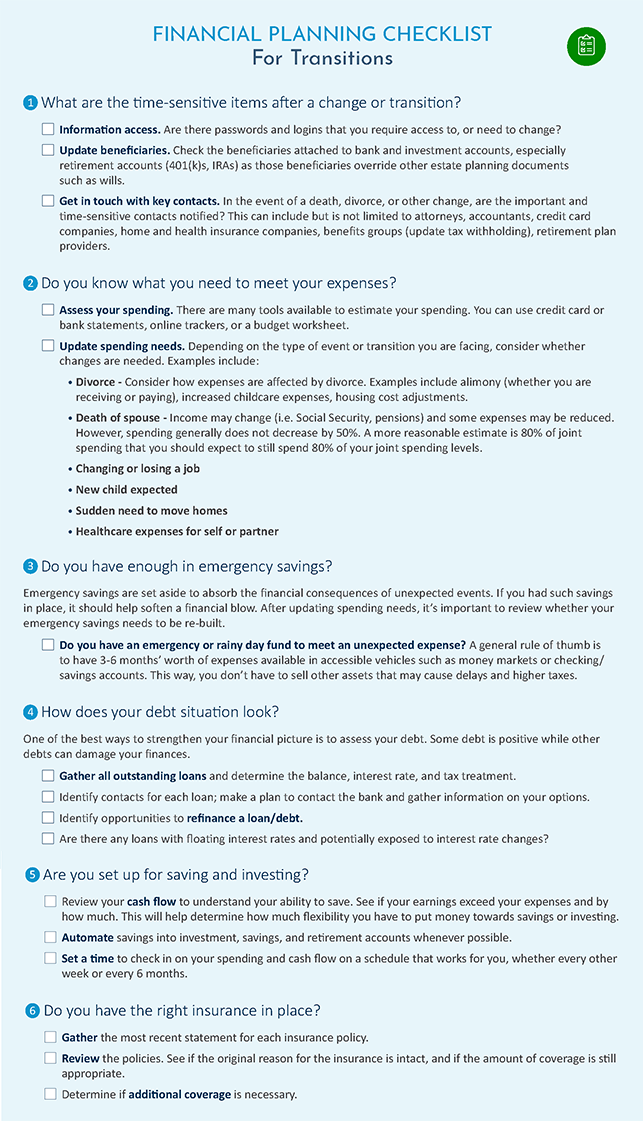
Throughout their lives, women face challenges at every turn in their careers, family situations, health, and more. We are here to work with you and highlight the financial tools and strategies available to address and mitigate these challenges. Our Financial Planning Checklist for Transitions is one example of a tool you can use to prepare for the unexpected.
At 1919 Investment Counsel, we seek to listen, understand your needs, and bring clarity to complex challenges. We are committed to finding the right solutions for you, and to delivering clear, compassionate, and flexible wealth management services to help you meet your goals.
Interested in learning more? Visit 1919ic.com and start the conversation.
FOOTNOTES
1. Murphy, Sherry L., et al. “Mortality in the United States, 2023.” NCHS Data Brief, vol. 521, Dec. 2024.
2. U.S. Bureau of Labor Statistics, The Economics Daily. “Women’s earnings were 83.6 percent of men’s in 2023.” Mar. 2024.
3. Yakoboski, Paul J., et al. “Financial literacy and retirement fluency in America.” 2025 TIAA Institute-GFLEC Personal Finance Index.
4. “Retirement Planning for Women: Why the Stakes Are Higher.” Morgan Stanley At Work, Morgan Stanley Smith Barney LLC. Member SIPC., Mar. 2025.
5. “National health expenditure data (NHE) Fact Sheet.” Centers for Medicare & Medicaid Services, Dec. 2024.
6. AARP and National Alliance for Caregiving. Caregiving in the United States 2020. Washington, DC: AARP. May 2020.
7. “Women and Giving.” Fidelity Charitable, 2021.
8. Murphy, Sherry L., et al. “Mortality in the United States, 2023.”
9. Goodman, Benny. “Longevity literacy: Preparing for 100-year lives?” Trends and Issues, TIAA Institute, June 2023.
10. U.S. Bureau of Labor Statistics, The Economics Daily. “Women’s earnings were 83.6 percent of men’s in 2023.” Mar. 2024
11. Gould, Elise. “Gender wage gap persists in 2023.” Working Economics Blog, Economic Policy Institute, Mar. 2024.
12. “When the career ladder breaks for women — and how to succeed anyway.” The McKinsey Podcast, McKinsey & Co., Mar. 2025.
13. Kelly, Allie. “Balancing kids and career.” Business Insider, Apr. 2025.
14. Madgavkar, Anu, et al. “Tough trade-offs: How time and career choices shape the gender pay gap.” McKinsey Global Institute, McKinsey Global Institute, Feb. 2025.
15. “Equitable Study Reveals that Relationship Status Influences Financial Behaviors and Mindsets for Women.” Equitable, Dec. 2023.
16. “How Women Are Financially Affected by Divorce.” Creative Planning, Feb. 2022.
17. Lin, I-Fen, and Susan L. Brown. “The Economic Consequences of Gray Divorce for Women and Men.” The Journals of Gerontology Series B: Psychological Sciences and Social Sciences, vol. 76, no. 10, Sept. 2020.
18. “Health Insurance Coverage by State.” National Women’s Law Center, Apr. 2025.
19. Collins, Sara R., et al. “2024 State Scorecard on Women’s Health and Reproductive Care.” The Commonwealth Fund, July 2024.
20. Goodbout, Ted. “Here’s How Much Retirees May Need for Healthcare Costs.” National Association of Plan Advisors, July 2024.
21. “U.S. Personal Health Care Spending by Age and Gender 2010 Highlights.” Centers for Medicare & Medicaid Services, 2010.
22. Gumas, Evan D., et al. “The Unequal Weight of Caregiving: Women Shoulder the Responsibility in 10 Countries.” The Commonwealth Fund, Mar. 2024.
23. Schier-Akamelu, Rebecca. “2023 Caregiver Burnout and Stress Statistics.” A Place for Mom, June 2023.
24. Hoyt, Jeff. “Nursing Home Costs in 2025.” SeniorLiving.org, May 2025.
25. “Women and Giving.” Fidelity Charitable, 2021.
About 1919 Investment Counsel
1919 Investment Counsel is a registered investment advisor. Its mission for more than 100 years has been to provide investment counsel and insight that helps families, individuals, and institutions achieve their financial goals. The firm is headquartered in Baltimore and has offices across the country in Birmingham, Cincinnati, New York, Philadelphia, San Francisco and Vero Beach. 1919 Investment Counsel seeks to consistently deliver an extraordinary client experience through its independent thinking, expertise and personalized service. To learn more, please visit our website at 1919ic.com.
Disclosures
The information provided here is for general informational purposes only and should not be considered an individualized recommendation or personalized investment advice. No part of this material may be reproduced in any form, or referred to in any other publication, without the express written permission of 1919 Investment Counsel, LLC (“1919”). This material contains statements of opinion and belief. Any views expressed herein are those of 1919 as of the date indicated, are based on information available to 1919 as of such date, and are subject to change, without notice, based on market and other conditions. There is no guarantee that the trends discussed herein will continue, or that forward-looking statements and forecasts will materialize. This material has not been reviewed or endorsed by regulatory agencies. Third party information contained herein has been obtained from sources believed to be reliable, but not guaranteed.
There is no guarantee that employees named herein will remain employed by 1919 for the duration of any investment advisory services agreement.
1919 Investment Counsel, LLC is a registered investment advisor with the U.S. Securities and Exchange Commission. 1919 Investment Counsel, LLC, a subsidiary of Stifel Financial Corp., is a trademark in the United States. 1919 Investment Counsel, LLC, One South Street, Suite 2500, Baltimore, MD 21202. ©2025, 1919 Investment Counsel, LLC. MM-00002044
Published: October 2025