










Executive Summary
Last week’s sharp equity market correction highlights an increasingly challenging investment environment as concerns surrounding AI valuations, financing requirements, and more restrictive monetary policy weigh on investor confidence. Nevertheless, resilient consumer spending, limited layoffs, and strong corporate earnings suggest the underlying economic expansion remains intact. While volatility may persist, we continue to favor a disciplined, long-term investment approach that emphasizes diversification, quality, and the benefits of staying invested through market cycles.
Key Takeaways:
- Equity markets experienced a sharp correction. The S&P 500 declined 8.57% last week, while the NASDAQ Composite fell nearly 10%, with selling pressure extending beyond technology and AI-related companies. Treasury yields also declined, reflecting growing concerns about the economic impact of tighter financial conditions.
- AI fundamentals remain strong, but investors are becoming more selective. Nvidia delivered exceptional earnings and raised its long-term growth outlook, while Anthropic completed a historic IPO. However, concerns surrounding valuations, financing requirements, corporate governance, and sustainable profitability continue to weigh on the sector.
- Economic growth remains resilient but increasingly uneven. October retail sales and consumer spending remained healthy, while improving consumer sentiment and declining inflation expectations bolstered confidence. Nevertheless, elevated borrowing costs and recent weakness in equity markets could increasingly weigh on household confidence and spending.
- Federal Reserve policy and regulatory uncertainty pose growing risks. Policymakers signaled support for additional interest-rate increases, with markets pricing a December hike as highly likely. Meanwhile, new restrictions on exports of advanced AI chips, fading fiscal stimulus, and unresolved geopolitical tensions pose potential headwinds to growth.
- Long-term discipline remains essential. Market corrections are a normal part of investing, and history underscores the importance of staying invested through periods of volatility. Strong corporate fundamentals continue to support the longer-term outlook, reinforcing the value of diversification, quality investments, and disciplined attention to valuation.
Financial Markets
U.S. equity markets suffered significant declines last week as the ongoing correction in artificial intelligence-related stocks intensified and selling pressure spread across the broader market. The capitalization-weighted S&P 500 fell 8.57%, bringing its decline from the October 6th high to 11.6%, while the technology-heavy NASDAQ Composite lost nearly 10% for the week and now stands roughly 19.1% below its October peak. Small-cap stocks and the equal-weighted S&P 500 performed comparatively better. Still, the magnitude of these losses demonstrates that weakness is no longer confined to a narrow group of mega-cap technology companies.
| Index | Prior Week | Year-to-Date | 1-Year |
|---|---|---|---|
| S&P 500 | -8.57% | 1.98% | 6.91% |
| S&P 500 Equal Weighted | -6.21% | 9.77% | 15.87% |
| Dow Jones Industrial Avg. | -7.96% | 1.57% | 6.95% |
| NASDAQ Composite | -9.99% | -2.18% | 3.05% |
| Small Cap S&P 600 | -6.65% | 10.13% | 18.72% |
| MSCI EAFE | -5.95% | 7.57% | 11.94% |
| MSCI Emerging Markets | -8.17% | 4.25% | 6.85% |
Artificial intelligence remains at the center of the market’s weakness, with semiconductors, memory producers, and specialized AI cloud infrastructure providers, commonly referred to as neoclouds, experiencing particularly sharp declines. Importantly, the selloff has occurred despite continued evidence of exceptional demand for computing infrastructure. Nvidia reported another outstanding quarter, with revenue more than doubling from a year earlier, and management raised its fiscal 2028 revenue growth outlook to approximately 75%, up from its previous expectation of 70%. These results reinforced the strength of the underlying AI investment cycle but were insufficient to overcome investor concerns about Nvidia’s recent leadership uncertainty, executive oversight, and operational continuity.
Meanwhile, Anthropic’s highly anticipated initial public offering attracted substantial institutional demand and raised $93.5 billion, making it another landmark transaction for the AI industry. However, the offering failed to restore momentum across the broader AI trade. Together, these developments highlight an important distinction: investors are not necessarily questioning the demand for artificial intelligence, but rather the valuations, financing structures, and ultimate profitability of the companies supporting its development.
Fixed-income markets provided an important counterpoint to the equity selloff. Despite increasingly hawkish Federal Reserve commentary, Treasury yields declined throughout the week, with the 10-year yield falling from 5.15% to 4.94% and the policy-sensitive 2-year yield declining from 4.88% to 4.64%. The move suggests investors are becoming more concerned that elevated borrowing costs, weakening equity prices, and tighter financial conditions could eventually weigh on economic growth. The decline in stock prices is particularly relevant given the support household consumption has received from rising financial wealth in recent years. A sustained market correction could weaken that wealth effect, encouraging households to moderate discretionary spending and potentially reinforcing an economic slowdown.
Encouragingly, markets are beginning the new week with a substantial rebound, led by many of the technology and AI-related companies that experienced the sharpest losses last week. This morning, Nvidia announced that Jensen Huang would return as CEO effective immediately, helping restore confidence in the company’s leadership and providing a catalyst for the broader recovery. While the development removes an important source of company-specific uncertainty, it does not resolve the larger questions surrounding AI financing, valuations, and monetary policy. Whether the rebound develops into a more durable recovery will likely depend on continued earnings strength and improving confidence in the broader economic outlook.
Economics
Recent economic data continue to point to a resilient but increasingly uneven U.S. economy. October retail sales rose 0.2% month over month, slowing from September’s 0.8% gain, although underlying spending was stronger, with the GDP-related control group advancing 0.6%. Annual retail sales growth reached 6.8%, its strongest pace since October 2022. Additional spending data from Bank of America reinforced this constructive picture, with the bank reporting that card spending increased 5.8% from a year earlier in October, including relatively strong gains among lower-income households. Nevertheless, consumers appear increasingly selective, favoring essential purchases and services over discretionary goods. Consumer sentiment also improved, with the University of Michigan’s November index rising to 51.5 following the midterm elections. Encouragingly, year-ahead inflation expectations declined to 3.7% from 4.7%, while longer-term expectations eased to 3.3% from 3.5%, supported in part by lower gasoline prices. However, sentiment remains 9% below February’s pre-Iran-war level, and inflation remains consumers’ primary concern. The survey also revealed divergent household experiences, with lower- and middle-wealth consumers reporting improved finances, while wealthier households expressed greater concern amid recent equity-market volatility. Taken together, consumer spending, improving inflation expectations, and limited layoffs continue to support the expansion. However, elevated borrowing costs, declining financial wealth, and the prospect of additional Federal Reserve tightening could increasingly weigh on household confidence and economic growth.
Policy
Federal Reserve communication turned increasingly hawkish last week as policymakers reinforced their commitment to restoring price stability despite heightened financial market volatility. Minutes from the October Federal Open Market Committee (FOMC) meeting showed broad support for additional tightening after the Committee held rates unchanged at 3.75%-4.00%, with two dissenters favoring an immediate 25-basis-point increase. Nearly all participants viewed further tightening as appropriate, while some suggested larger increases could be warranted if inflation remains persistent. Subsequent commentary reinforced this stance, although officials differed on the appropriate pace. Governor Waller advocated for a 50-basis-point increase in December unless the Fed clearly signals another hike in January, arguing that decisive action may be necessary to prevent inflation near 3% from becoming entrenched. St. Louis Fed President Musalem similarly supported multiple increases, while New York Fed President Williams favored a more measured approach. Other officials, including governors Goolsbee, Jefferson, and Barr, emphasized persistent inflation risks, particularly from strong AI-related investment demand. Futures markets now assign approximately a 95% probability to a 25-basis-point increase in December, underscoring expectations that monetary policy will become more restrictive.
The broader policy environment is becoming increasingly challenging as additional monetary tightening intersects with other potential headwinds to growth. Elevated borrowing costs and declining financial-asset prices are already tightening financial conditions, while the fiscal stimulus associated with this year’s tax and spending measures may begin to fade. Renewed concerns about a potential government shutdown and the evolving impact of tariffs introduce additional uncertainty. At the same time, the Trump administration announced new restrictions aimed at preventing China and other countries of concern from accessing advanced U.S. computing technology through overseas data centers. Expanded due diligence and export licensing requirements will affect advanced semiconductor shipments to several countries, including Malaysia, Singapore, Indonesia, Thailand, and Brazil, while also addressing remote access to U.S. computing resources. Although intended to protect national security and preserve America’s technological advantage, these measures could increase costs, delay infrastructure development, and complicate financing for AI-related companies. Taken together, monetary, fiscal, trade, and regulatory policies that previously supported growth are increasingly becoming potential sources of restraint, raising the risk of a more pronounced economic slowdown.
Geopolitical developments provided little additional clarity. The highly anticipated trilateral meeting between President Trump, Chinese President Xi Jinping, and Russian President Vladimir Putin at the Asia-Pacific Economic Cooperation (APEC) summit in Shenzhen yielded little concrete progress, despite discussions covering nuclear arms reduction, Ukraine, Iran, Taiwan, and global energy security. The leaders emphasized continued dialogue and cooperation to maintain stable energy supplies, but significant disagreements remain, particularly over Taiwan, the war in Ukraine, and broader strategic competition. While the meeting avoided a further escalation in tensions, it did little to resolve the underlying disputes. For financial markets, geopolitical uncertainty therefore remains an important source of risk through its potential effects on energy prices, international trade, and inflation, particularly as central banks become more restrictive and economic growth faces increasing headwinds.
Conclusion
Last week’s sharp market correction highlights an increasingly challenging investment environment, particularly for technology and AI-related companies. Despite exceptional corporate earnings, robust demand for AI infrastructure, and Anthropic’s historic public offering, investors are becoming more discerning about valuations, financing requirements, and sustainable profitability. Increasingly hawkish Federal Reserve commentary, tighter financial conditions, and growing concerns about economic growth have further narrowed the market’s margin for error. Nevertheless, the underlying economic expansion remains intact, supported by resilient consumer spending, limited layoffs, and improving inflation expectations.
Importantly, volatility and market corrections are normal features of long-term equity investing. Since 1990, the S&P 500 has experienced an average intra-year decline of nearly 14% yet has finished with a positive annual return in 29 of the 36 years through 2025. Moreover, a relatively small number of strong trading sessions have historically accounted for a disproportionate share of long-term returns, making attempts to time market exits and reentries particularly challenging. These historical patterns reinforce the importance of remaining invested through periods of uncertainty and allowing the power of compounding to work over time. While near-term volatility can be uncomfortable, maintaining a disciplined investment approach has generally proven more effective than reacting to short-term market fluctuations.
S&P 500 Calendar Year Return vs. Largest Intra-Year Decline
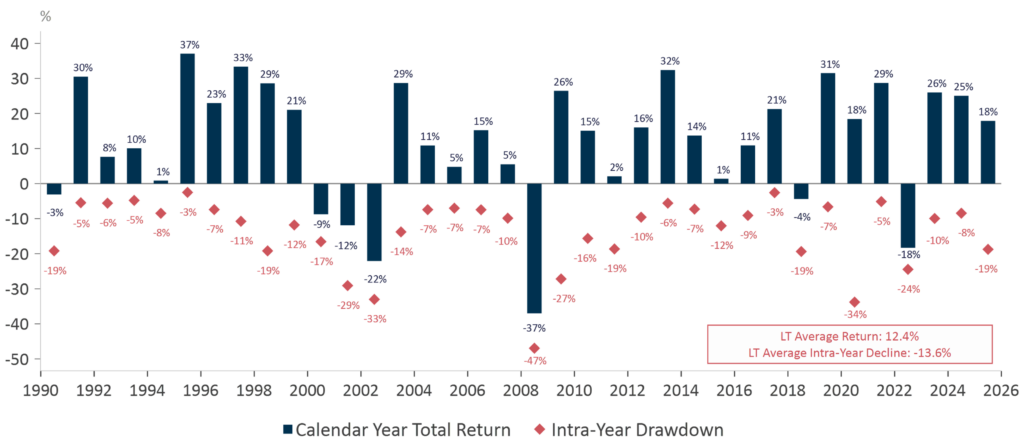
Source: Macrobond, S&P 500 Total Return Index (sp500_500tr)
Data: Available from 1989 to 2026
Looking ahead, we continue to expect moderate economic growth and healthy corporate earnings to support equity markets, although the path is unlikely to be smooth. The central question is whether inflation can moderate sufficiently to prevent the Federal Reserve from overtightening as elevated borrowing costs and declining asset prices gradually affect economic activity. In this environment, diversified portfolios emphasizing quality businesses, durable free cash flow, strong balance sheets, and reasonable valuations remain appropriate. High-quality fixed income also provides attractive income and diversification benefits, although inflation and interest-rate risks warrant continued attention. Ultimately, maintaining a disciplined, long-term perspective remains essential for navigating volatility while positioning to benefit from continued economic expansion and market growth.
The information provided here is for general informational purposes only and should not be considered an individualized recommendation or personalized investment advice. No part of this material may be reproduced in any form, or referred to in any other publication, without the express written permission of 1919 Investment Counsel, LLC (“1919”). This material contains statements of opinion and belief. Any views expressed herein are those of 1919 as of the date indicated, are based on information available to 1919 as of such date, and are subject to change, without notice, based on market and other conditions. There is no guarantee that the trends discussed herein will continue, or that forward-looking statements and forecasts will materialize.
Statements concerning financial market trends or portfolio strategies are based on current market conditions, which will fluctuate. There is no guarantee that these investment strategies will work under all market conditions or are appropriate for all clients and each client should consider their ability to invest for the long term, especially during periods of downturn in the market. No representation is being made that any account, product, or strategy will or is likely to achieve profits, losses, or results similar to those shown.
All investments carry a degree of risk and there is no guarantee that investment objectives will be achieved. Information provided herein should not be relied upon as investment advice or a recommendation of any particular security.
This material has not been reviewed or endorsed by regulatory agencies. Third party information contained herein has been obtained from sources believed to be reliable, but not guaranteed.
There is no guarantee that employees named herein will remain employed by 1919 for the duration of any investment advisory services arrangement.
1919 Investment Counsel, LLC is a registered investment advisor with the U.S. Securities and Exchange Commission. 1919 Investment Counsel, LLC, a subsidiary of Stifel Financial Corp., is a trademark in the United States. 1919 Investment Counsel, LLC, One South Street, Suite 2500, Baltimore, MD 21202. ©2026, 1919 Investment Counsel, LLC. MM-00002805
Investment Analysis
The information shown herein is for illustrative purposes. 1919 may consider additional factors not listed here or consider some, but not all, of the factors listed here as appropriate for the strategy’s objectives.
There is no guarantee that desired objectives will be achieved. 1919 has a reasonable belief that any third party information used for investment analyses purposes is reliable but does not represent to the complete accuracy of such information by any third party.
Portfolio Composition
For illustrative purposes. There is no guarantee that the portfolio composition for the strategy discussed herein will be comparable to the portfolio shown here.